
Why this guide
Most organizations say they prioritize workplace well-being, but few measure it before investing. The result: programs launched blind, impossible to defend at the next budget cycle, and employees who don't feel heard.
This survey gives you a numbers-based starting point in less than a week, with no consultant and no software licence. Twenty questions across six dimensions cover physical energy, workload, mental health, recognition, healthy habits and engagement with your current program.
You walk away with a single number to present to leadership, a grid showing which dimensions are in the action zone, and a ready-to-send invitation email. This is the prerequisite before deciding where to invest.
The 6 dimensions measured
A useful well-being survey doesn't ask twenty random questions: it covers distinct dimensions so you know exactly where to act. Ours measures six: physical health and energy, workload and stress, mental health and psychological safety, recognition and belonging, healthy habits, and program and engagement. Each dimension has three statements, which gives you a reliable average without stretching the survey past ten minutes.
Preview: the first 10 questions
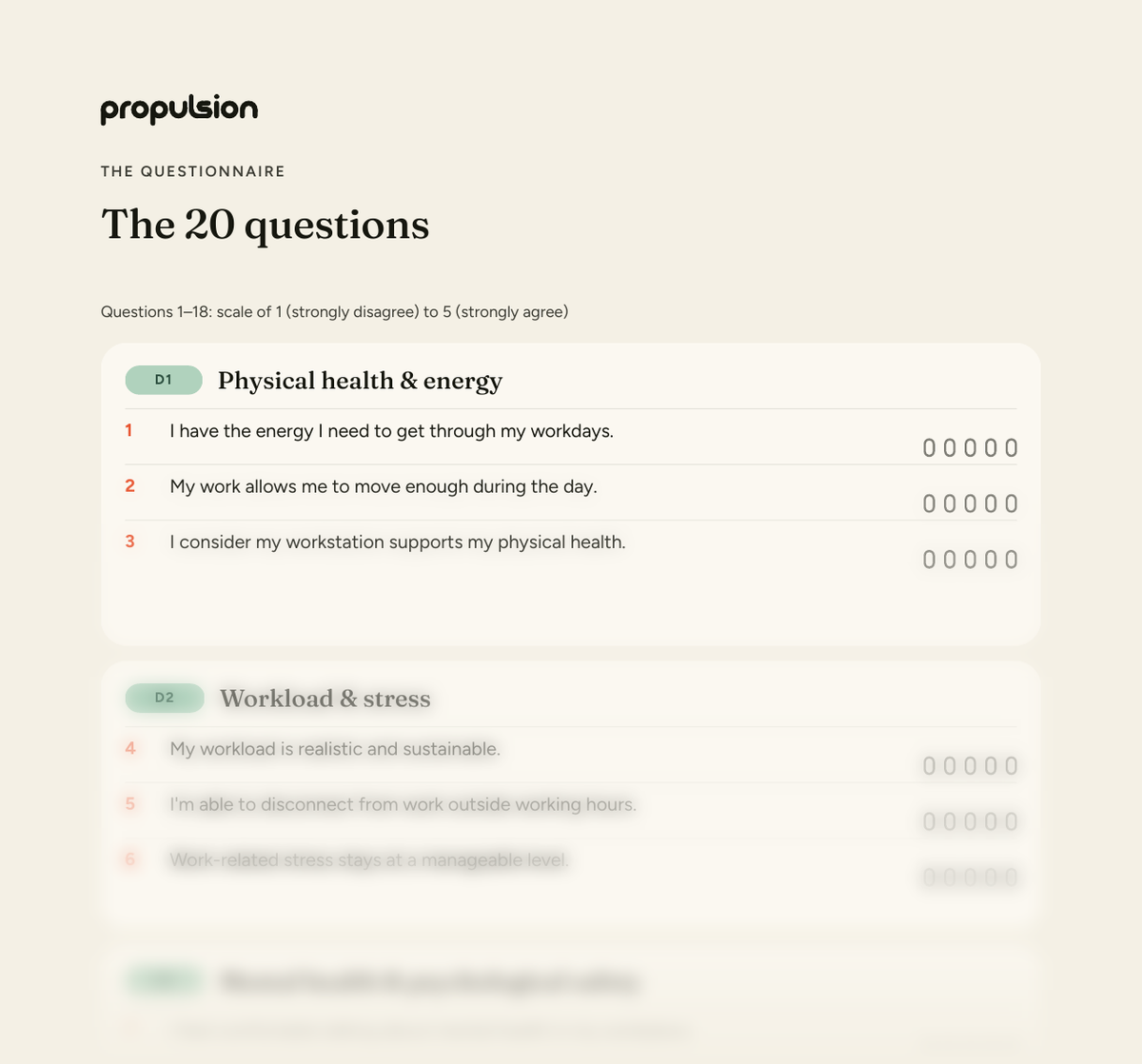
Here are the first ten questions of the survey, exactly as they appear in the document. Each statement is answered on a scale of 1 (strongly disagree) to 5 (strongly agree).
Physical health and energy
1. I have the energy I need to get through my workdays.
2. My work allows me to move enough during the day.
3. I consider my workstation supports my physical health.
Workload and stress
4. My workload is realistic and sustainable.
5. I'm able to disconnect from work outside working hours.
6. Work-related stress stays at a manageable level.
Mental health and psychological safety
7. I feel comfortable talking about mental health in my workplace.
8. I know who to turn to in the organization if I'm going through a difficult time.
9. My manager genuinely cares about my well-being.
Recognition and belonging
10. My efforts are recognized at their fair value.
The next ten questions, the full analysis grid and the invitation email template are in the downloadable document.
How to interpret your results
Average the three questions of each dimension, then place that average in one of three zones. Between 4.0 and 5.0, you're in the strength zone: maintain and communicate what works, it's a retention argument. Between 3.0 and 3.9, you're in the watch zone: dig deeper with a focus group before investing, the need exists but isn't urgent. Below 3.0, you're in the action zone: announce a concrete measure within 30 days.
One simple rule prevents dilution: never tackle more than two dimensions in the action zone at once. Visible progress on one dimension beats a diluted plan across five.
Anonymity, frequency and participation rate
Anonymity is non-negotiable. Collect no identifiers and never analyze results in groups smaller than five respondents, or answers become identifiable again. Use a third-party tool like Google Forms or Microsoft Forms rather than email replies.
On frequency, a full survey once or twice a year is enough, complemented by short three-to-five-question pulses each quarter. Aim for a participation rate of 60% or higher: below 40%, results over-represent extreme opinions and it's better to send a reminder before drawing conclusions.
What to do with the results
The golden rule: surveying without acting afterwards does more harm than not surveying at all. Share your findings with teams within 30 days of closing, including the unflattering ones, and announce one or two concrete actions rather than a twelve-point plan.
If your Healthy habits or Program and engagement dimensions land in the watch or action zone, a team health challenge is often the fastest and most visible action to deploy, with no additional burden on HR.