Workplace well-being
Sports in the Workplace: The Best Physical Activity Programs for Your Teams
- Active employees take 27% fewer sick days and are 35% more productive than their sedentary colleagues
- Team challenges achieve an average 78% participation rate versus 23% for individual programs
- A well-designed physical activity program generates an ROI of $3 for every dollar invested
- The key to success: offer variety to reach all profiles, from the most active to the most sedentary
- Propulsion automates team challenges and boosts wellness accounts based on activity participation
Why Physical Activity at Work is a Strategic Priority
Workplace sedentary behaviour is a silent epidemic. According to Statistics Canada, Canadian workers spend 65% to 73% of their day being sedentary regardless of occupation, and no occupational group meets Canadian physical activity guidelines. This is associated with significantly increased cardiovascular risk, chronic stress, and mental fatigue. For HR teams, the consequences are direct: high absenteeism, declining productivity, and retention challenges.
Conversely, companies that have implemented structured physical activity programs consistently report measurable results: 27% fewer sick days, 35% improvement in productivity, and an average ROI of $3 for every dollar invested in the program. This is not an expense; it is an investment in human capital.
The 5 Best Physical Activity Programs to Implement
1. Team challenges with leaderboards
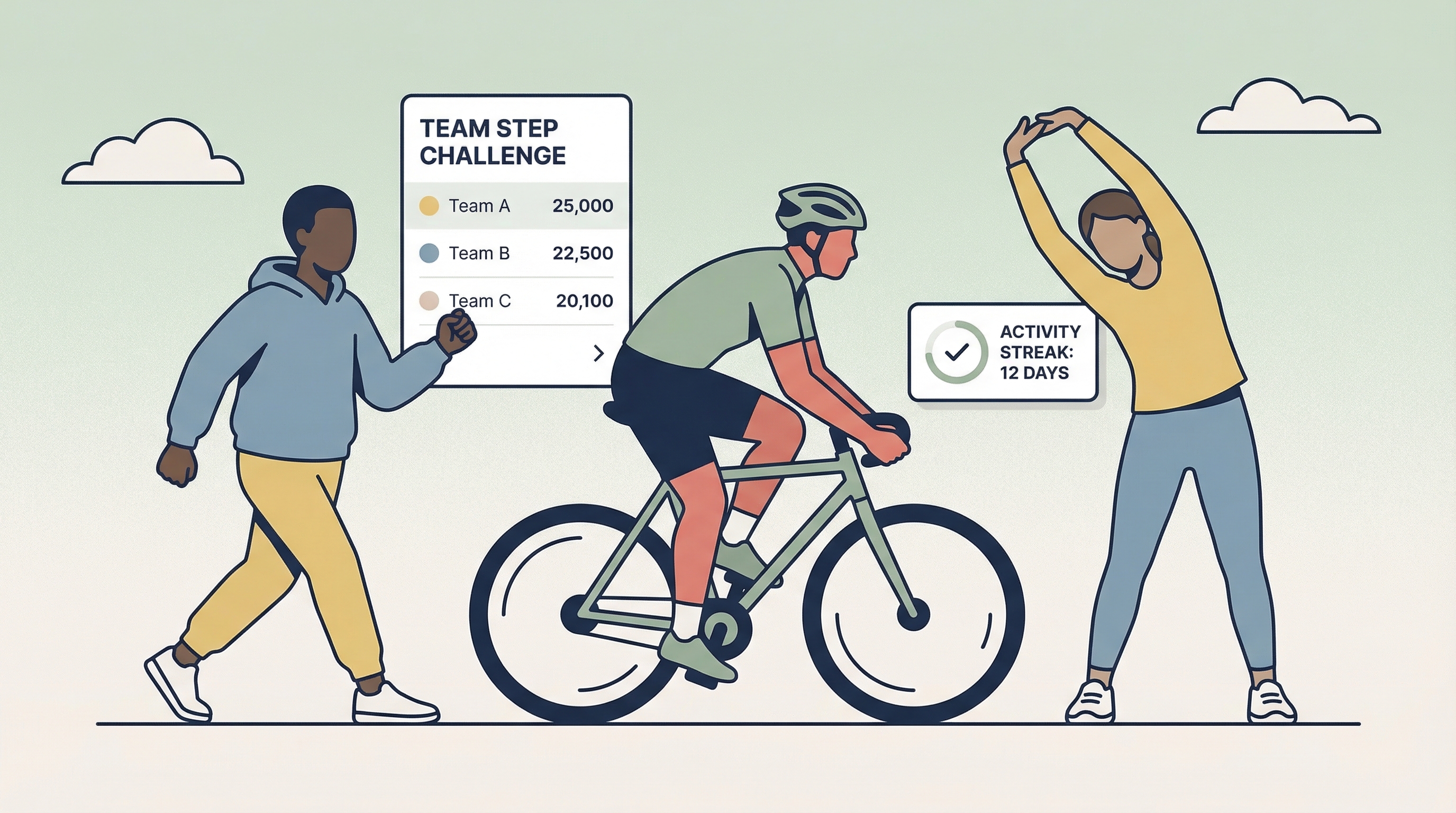
The most effective program in terms of participation. Team challenges transform individual physical activity into a collective experience, creating gentle social accountability that maintains engagement far beyond what an individual program can achieve. Average participation rate: 78% versus 23% for individual challenges.
Most popular formats: cumulative step challenges, virtual team races, multi-activity challenges with a points system. The key: a visible leaderboard updated in real time that teams can check from their phones.
2. Guided active breaks
Sessions of 10 to 15 minutes, 2 to 3 times per week, integrated into the work schedule. Yoga, stretching, light cardiovascular exercises: the goal is to break the structural sedentary nature of the office day without requiring significant athletic commitment.
The advantage of active breaks: they reach employees who would never participate in a running or step challenge. The short, guided format eliminates the usual barriers to entry.
3. Cycling and active transportation program
Encouraging employees to commute by bike, on foot, or by public transit with a walk. This program combines regular physical activity with positive environmental impact, two values that resonate strongly with millennial and Gen Z employees.
- Required infrastructure: Secure bike parking, locker rooms and showers if possible
- Financial incentives: 50 to 150 dollar monthly reimbursement for employees who actively commute at least 3 days per week
- Monthly challenge: Count active commute days per team with a visible leaderboard
4. Virtual activity platform
Particularly relevant for hybrid and remote teams. Access to an online class platform (yoga, pilates, cardio training, meditation) allows employees to move at their own pace, from anywhere.
The main selection criterion: the platform must be accessible on mobile, offer sessions under 30 minutes to fit into a workday, and cover varied intensity levels to reach all profiles.
5. Flexible wellness accounts
The most inclusive and customizable program. Rather than imposing a specific activity, the wellness allowance lets each employee choose the physical activity that suits them: gym membership, swimming lessons, running gear, cycling, martial arts.
Recommended amounts: $500 to $1,000 per employee per year for a significant impact on habits. With Propulsion, this amount can be automatically boosted based on challenge participation, creating a direct incentive to be active.
How to Choose the Right Program for Your Company
There is no universal program. The choice depends on several factors:
- Company size: Small teams benefit more from internal challenges where everyone knows each other. Larger companies benefit from variety and department-level programs.
- Work mode: In-person, hybrid, or remote determines which programs are feasible. An office gym does not benefit remote teams.
- Available budget: Team challenges via a digital platform are low cost. Physical facilities represent a larger investment.
- Employee profile: A young, sporty team will be receptive to running challenges. A more mixed team will benefit from more accessible entry-level programs like step challenges.
Keys to Success for Maximizing Participation
- Visible leadership involvement: When managers actively participate, team participation increases by 25% on average. Culture is created by example.
- Regular communication: Weekly reminders, leaderboard updates, sharing successes in internal channels. Physical activity must be visible in company culture.
- Format variety: Offering only running challenges excludes less active employees. A complete program includes formats accessible to all levels.
- Recognizing participation: Reward consistency, not just performance. The employee who walks 7,000 steps every day deserves as much recognition as the one who does 15,000 once a week.
- Measurement and adjustment: Participation rates, satisfaction, impact on absenteeism. Measuring allows adjusting and justifying the budget to leadership.
How Propulsion Simplifies Everything
Implementing and managing multiple physical activity programs simultaneously represents a significant administrative burden for HR teams. Propulsion centralizes everything: challenge creation, automatic activity tracking via the app, real-time leaderboards, re-engagement notifications, and wellness account management with activity-based bonuses.
The result: you launch a complete program in less than a day, and Propulsion handles operations while you focus on strategy and results.
Keep reading
Physical activity is only one strand of the program. For the full picture, 50 employee wellness program ideas sorted by theme place each initiative in a coherent plan. Since the collective challenge is the most mobilizing format, the complete corporate wellness challenge guide is the playbook.
Frequently Asked Questions
What is the minimum budget to launch a corporate physical activity program?
A basic team challenge program can start with as little as $5 to $10 per employee per month with a digital platform. More complete programs including wellness accounts and guided activities range from $50 to $150 per employee per month. The minimum investment to achieve measurable impact is around $500 per employee per year.
How do you convince leadership to invest in a physical activity program?
Present the cost of inaction rather than the cost of the program. An absent employee costs an average of $700 per day of absenteeism in direct and indirect costs. An absenteeism rate reduced by 20% on a team of 50 people represents significant annual savings. Add the impact on retention (replacing an employee costs between 50 and 200% of their annual salary) and the ROI becomes obvious.
How do you maintain participation after the initial weeks of enthusiasm?
Participation naturally drops after week 2 of any program without a re-engagement mechanism. The most effective strategies: renew challenges regularly rather than one long program, send personalized notifications to inactive participants, create celebration moments at the midpoint, and vary activity types to maintain novelty.
Do physical activity programs work for fully remote teams?
Yes, often better than in-person because they create bonds between colleagues who do not see each other physically. Step challenges, virtual races and wellness accounts work perfectly remotely. The important thing is to choose formats that require no calendar synchronization and a platform accessible on mobile from anywhere.