
Corporate challenges
50 Health Challenge Ideas for Employees (2026)
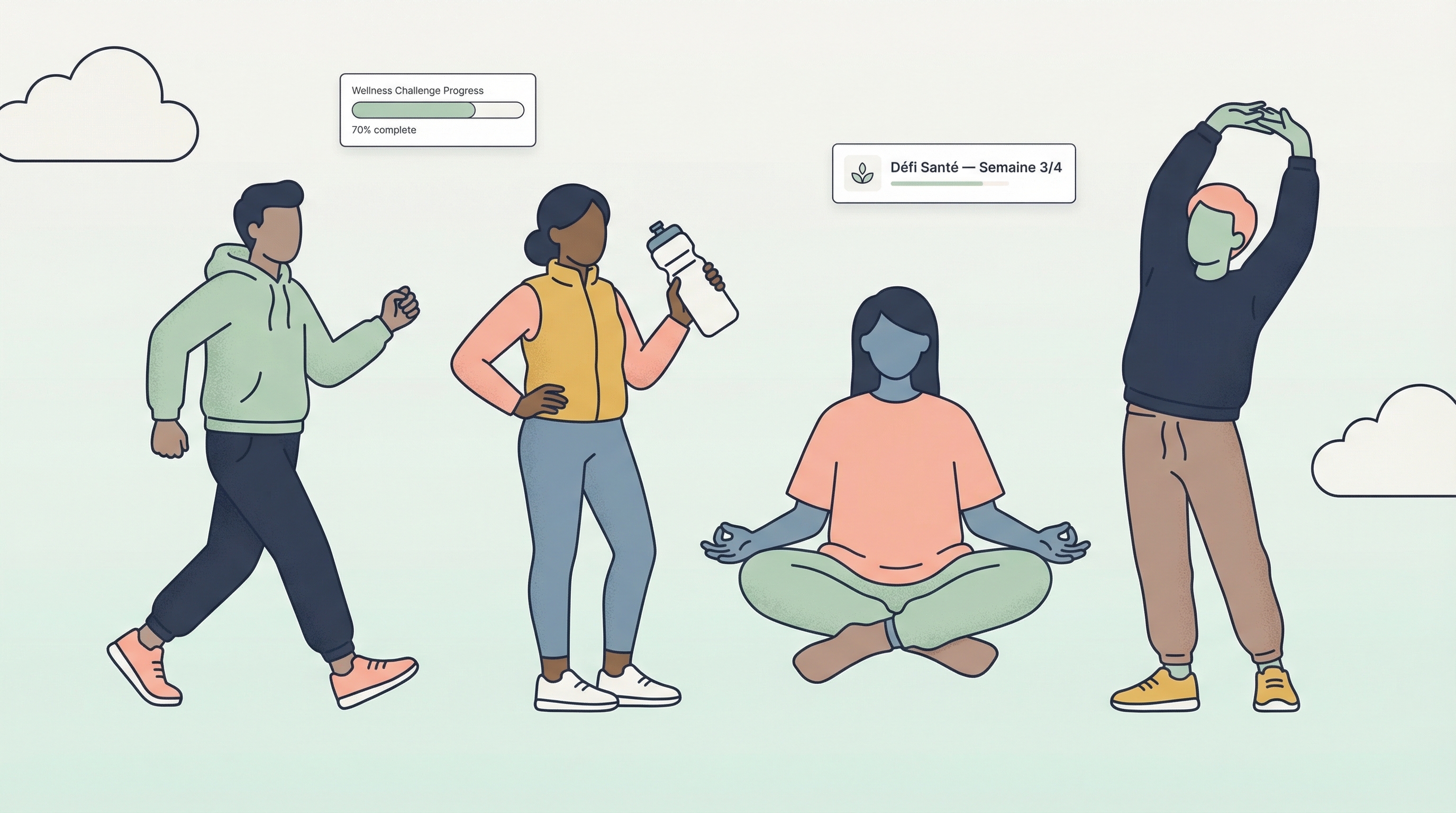
- Step challenges remain the most popular because they are accessible to all fitness levels
- Varying categories (nutrition, sleep, mental health) maintains engagement throughout the year
- Team challenges generate 40% more participation than individual challenges
- A 4-week challenge is optimal: long enough to build a habit, short enough to maintain urgency
- Propulsion automates tracking and boosts wellness accounts based on participation
Why Health Challenges Actually Work
Traditional wellness programs fail for one simple reason: they lack structure and collective engagement. A well-designed health challenge changes everything: it creates friendly competition, team accountability, and measurable results that HR can present to leadership.
Here are 50 ideas organized by category, from the simplest to launch to the most ambitious, with recommendations on the ideal duration and format for each.
Physical Activity and Step Challenges
These are the most accessible challenges: no equipment required, suitable for all fitness levels.
- 10,000 steps per day challenge: The classic. Simple, measurable, motivating. Ideal duration: 4 weeks.
- Team walking challenge: Pool steps as a team toward a common goal. Ex: virtually walk from New York to Chicago.
- Stair challenge: Ban the elevator for 2 weeks. Count floors climbed.
- 30 minutes of movement per day: Walking, cycling, yoga, everything counts. Maximum flexibility.
- Active breaks challenge: 5 minutes of movement every 2 hours. Ideal for remote teams.
- Virtual race challenge: Each employee runs/walks a distance and kilometers accumulate as a team.
- Outdoor activity challenge: 3 outdoor activities per week for one month.
- Bike to work challenge: Count days employees cycle or walk to work.
- Morning stretching challenge: 10 minutes of guided stretching before starting the day.
- Active weekend challenge: Share a physical activity done over the weekend. Bonus points for new activities.
Nutrition and Hydration Challenges
Easy to implement, these challenges have a direct impact on energy and focus at work.
- 2 liters of water per day: Track daily hydration for 3 weeks.
- No added sugar challenge: Eliminate added sugar for 2 weeks. Share alternative recipes.
- Vegetables at every meal: At least 2 servings of vegetables at each main meal for 1 month.
- Home-cooked meal challenge: Bring lunch to work 4 out of 5 days for 3 weeks.
- Healthy breakfast challenge: Start each day with a balanced breakfast and share a photo.
- No afternoon caffeine: No coffee after 2pm for 2 weeks.
- Green smoothie challenge: One smoothie with green vegetables per day for 2 weeks.
- Mindful eating challenge: Eat without screens, mindfully, for 3 weeks.
- Culinary discovery challenge: Try one unfamiliar healthy food each week for 1 month.
- Healthy snacks challenge: Replace processed snacks with natural alternatives for 3 weeks.
Mental Health and Wellbeing Challenges
The most impactful challenges for reducing absenteeism and improving workplace climate.
- 10-minute meditation challenge: One guided session per day for 3 weeks. Apps like Calm or Headspace.
- Gratitude journal challenge: 3 elements of gratitude each morning for 2 weeks.
- Digital detox challenge: No screens 1 hour before bed for 2 weeks.
- Random acts of kindness: One act of kindness toward a colleague per day for 3 weeks.
- Stress management challenge: Test a new relaxation technique each week for 1 month.
- No social media at work: Disable social notifications during work hours for 2 weeks.
- Reading challenge: 20 minutes of reading (non-professional) per day for 1 month.
- Time in nature challenge: 30 minutes outside each day for 2 weeks.
- Meaningful conversation challenge: Have a real conversation (no phone) with a colleague every day.
- Conscious breathing challenge: 3 sets of deep breathing per day for 3 weeks.
Sleep and Recovery Challenges
Often overlooked in wellness programs, these challenges have a direct impact on productivity.
- 7-8 hours of sleep challenge: Track and maintain a regular sleep schedule for 3 weeks.
- Evening routine challenge: Establish a 30-minute routine before bed for 2 weeks.
- Active rest challenge: A 20-minute break after lunch when possible for 1 month.
- Tech-free bedroom challenge: Charge your phone outside the bedroom for 2 weeks.
- Consistent bedtime challenge: Same bedtime 7 days a week for 3 weeks.
Team and Cohesion Challenges
These challenges strengthen bonds between colleagues while improving health: a double impact for HR.
- Inter-department sports challenge: Walking or cycling tournament between teams with visible leaderboard.
- Shared recipes challenge: Each week, one employee shares their favorite healthy recipe.
- Collective healthy lunch: One healthy meal prepared together each month.
- Discovery activity challenge: The team tries a new physical activity together each month.
- Mutual support challenge: Each employee chooses a challenge partner to motivate each other.
- Wellness photo challenge: Share a daily photo of your health action in a dedicated channel.
- Wellness book club: Read the same health book as a team and discuss it.
- Car-free challenge: Come to work on foot, bike, or public transit for 2 weeks.
How Propulsion Simplifies Everything
Launching a challenge manually (creating the tracker, sending reminders, keeping the leaderboard updated, managing rewards) easily represents 5 to 10 hours of HR work per week. That's the main reason challenges fizzle out after the first week.
Propulsion centralizes everything: automatic step tracking via the app, real-time leaderboards, personalized notifications to re-engage lagging teams, and automatic wellness account bonuses based on participation. Your role is limited to choosing the challenge and celebrating the results.
Keep reading
Once the idea is picked, it still has to land. The complete HR guide to wellness challenges gives the frame (format, timeline, KPIs), and the playbook for organizing a sports challenge covers the rollout. For step challenges specifically, 50 formats sorted by goal help you avoid the generic one.
Frequently Asked Questions
What is the best health challenge to start with for inactive employees?
The step challenge is ideal for getting started. It's accessible to everyone, requires no equipment, and the goal of 10,000 steps can be adjusted downward (e.g., 7,000 steps) for less active employees. A team goal rather than individual goal reduces pressure on the less sporty participants.
How long should a corporate health challenge last?
4 weeks is the optimal duration. Less than 2 weeks doesn't allow time to build a habit. More than 6 weeks and fatigue sets in. To maintain engagement throughout the year, plan 6 to 8 four-week challenges with breaks in between.
How do you measure the success of a health challenge?
The 3 key indicators: participation rate (target: 60%+), completion rate (target: 70%+ of registered participants finish), and internal Net Promoter Score (would employees recommend doing this challenge again). Propulsion generates these reports automatically.
Should you offer rewards for health challenges?
Rewards increase participation by 25 to 40%. The most effective ones aren't necessarily the most expensive: a day off, a donation to a charity of the winning team's choice, or a wellness account bonus. Avoid food rewards that contradict the health objective.