
Employee engagement
How to Improve Employee Engagement: 20 Proven Strategies
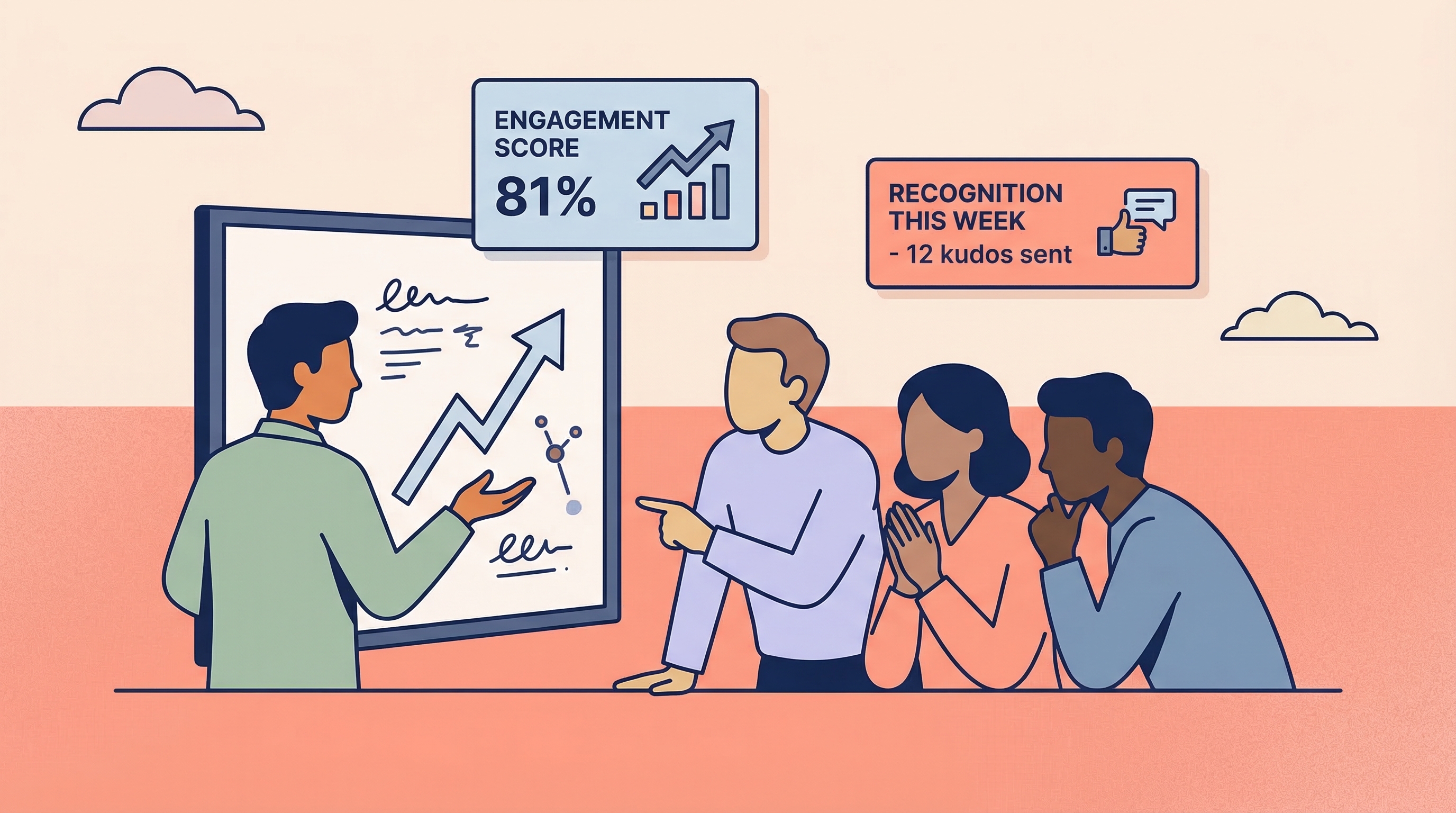
- Only 20% of employees worldwide were actively engaged in 2025 according to Gallup, a number that costs companies in lost productivity and high turnover
- Regular recognition is the most powerful and least expensive lever to improve engagement
- Engagement is built at the immediate team level, not the company level: the direct manager has more impact than corporate culture
- Collective wellness programs like team challenges improve engagement by creating strong social bonds between colleagues
- Propulsion combines wellness challenges, recognition and engagement tracking in a single HR platform
Why Employee Engagement is a Strategic Priority
The numbers are stark. According to Gallup's State of the Global Workplace report, 20% of employees worldwide were engaged at work in 2025, down from 23% in 2022. The rest fall into two very different groups: 64% are not engaged, doing the minimum without actively harming, and 16% are actively disengaged, draining the energy of those around them. North America does better than the global average at 31%, but that is still far from enough.
The cost of this disengagement is concrete: a company of 200 employees with 67% disengagement loses an average of 34% productivity on those employees, and bears turnover costs of 50 to 200% of annual salary with each departure. Engagement is not an abstract HR issue; it is a direct financial issue.
The 4 Pillars of Employee Engagement
Before choosing strategies, it is essential to understand what creates engagement. Gallup research identifies four fundamental needs that employees must have met to engage fully:
- Basic needs: Knowing what is expected of me and having the resources to do it
- Individual support: Having a manager who cares about my development and recognizes me
- Teamwork: Having engaged colleagues and a sense of belonging to the team
- Growth: Having opportunities to learn, progress and contribute to something meaningful
The 20 strategies that follow are organized around these four pillars.
Recognition and Feedback Strategies
Recognition is the most powerful lever of engagement, and the most often neglected. An employee who feels seen and valued is an employee who invests themselves.
- 1. Regular public recognition: Specifically name contributions in team meetings, the intranet or Slack channel. Public recognition has 3 times more impact than private recognition.
- 2. Continuous feedback, not annual: Replace the annual review with short, regular 15-minute conversations every 2 weeks. Frequent feedback improves performance and reduces employee anxiety.
- 3. Peer recognition program: Allow employees to congratulate each other via a dedicated platform or channel. Horizontal recognition creates a sense of community that top-down recognition cannot replace.
- 4. Work anniversary celebrations: Publicly recognize 1, 3, 5 and 10-year milestones in a personalized way. A generic message is not enough: mention a specific contribution from the employee.
- 5. Visible success board: A physical or digital space where team achievements are permanently displayed, not just celebrated at project launches.
Development and Growth Strategies
Employees who see no future in their organization eventually stop investing in the present. Professional development is directly linked to long-term engagement.
- 6. Annual individual development plan: Each employee co-creates with their manager a plan with concrete learning goals for the year. Not an HR document but a real conversation about aspirations.
- 7. Training budget accessible to all: An annual amount dedicated to training that the employee chooses themselves: online courses, conferences, certifications. Freedom of choice increases the sense of autonomy and engagement.
- 8. Internal mentorship program: Structured pairing between junior and senior employees. The mentor feels valued, the mentee feels supported: a double impact on engagement.
- 9. Internal mobility encouraged: Post open positions internally before recruiting externally. Employees who know they can grow within the organization invest in it longer.
- 10. Personal project time allocated: Allow employees to dedicate 5 to 10% of their time to an innovative project of their choice. This principle, popularized by Google, generates extraordinary engagement and stimulates innovation.
Wellness and Social Cohesion Strategies
Engagement is not built solely in work meetings. Social bonds between colleagues are a major predictor of sense of belonging and desire to stay in the organization.
- 11. Collective wellness challenges: Team challenges like step competitions or multi-activity challenges create bonds between colleagues who do not normally interact. The social dimension of the challenge is as important as the health dimension.
- 12. Regular team building activities: One activity per quarter, outside the work context, to strengthen bonds between colleagues. The type of activity matters less than the regularity.
- 13. Random virtual coffee: A tool that randomly pairs two colleagues for a 20-minute coffee chat each week. Particularly effective for hybrid or remote teams where informal interactions are rare.
- 14. Collaborative workspaces: Office areas designed to encourage spontaneous conversations rather than siloed work. The physical environment directly influences the frequency of social interactions.
- 15. Complete wellness program: Offering flexible wellness accounts, mental health resources and physical activity programs sends a clear signal: the organization cares about its employees' overall well-being, not just their output.
Management and Culture Strategies
Engagement is built or destroyed at the direct manager level. A good HR program does not compensate for poor day-to-day management.
- 16. Manager training on engagement: Equip managers with concrete tools to have career conversations, recognize effectively and create a psychologically safe climate in their team.
- 17. Regular pulse surveys: Short surveys of 5 to 7 questions sent each quarter to measure the evolution of engagement. The most important: close the loop by communicating what has changed following the results.
- 18. Transparency on company strategy: Engaged employees understand where the organization is going and how their work contributes to it. Regular leadership communications on vision and results reinforce the sense of contribution.
- 19. Flexible work policy: Flexibility on hours and work location has become a major predictor of engagement, particularly for generations Y and Z. This is no longer a differentiating advantage; it is a baseline expectation.
- 20. Psychological safety culture: Creating an environment where employees can express ideas, ask questions and flag problems without fear of judgment or retaliation. Psychological safety is the foundation of sustainable engagement.
How to Measure Engagement in Your Teams
It is impossible to improve what you do not measure. Here are three complementary approaches to get a complete picture of engagement in your organization.
The annual engagement survey gives a global snapshot but suffers from a significant delay between collection and action. Quarterly pulse surveys allow you to detect drops in engagement before they become departures. Behavioral data (participation in initiatives, absenteeism rates, benefit usage) completes the picture with objective data that does not depend on willingness to respond to a survey.
Propulsion centralizes participation data from wellness challenges and activity programs, providing a behavioral engagement indicator that complements your traditional HR surveys.
Keep reading
Wellness is one of the fastest engagement levers to activate. 50 employee wellness program ideas provide the catalogue, and the corporate wellness challenge guide the most mobilizing format. On the benefits side, the employer guide to wellness spending accounts covers the allowance employees spend as they choose.
Frequently Asked Questions
What is the difference between employee satisfaction and engagement?
Satisfaction measures whether an employee is happy with their job: salary, conditions, atmosphere. Engagement measures whether an employee is invested in the success of the organization, whether they make discretionary efforts beyond their job description. An employee can be satisfied without being engaged: they are happy with their salary but do the bare minimum. Engagement is the predictor of performance and retention; satisfaction alone is not.
How long does it take to improve engagement in an organization?
The first measurable improvements generally appear after 3 to 6 months of consistent initiatives. A deep cultural transformation takes 18 to 36 months. The most common mistake is expecting immediate results and abandoning initiatives before they have had time to produce their effect. Consistency over 12 months is more effective than intensive interventions followed by a long period of inactivity.
What is the impact of remote work on employee engagement?
Remote work has an ambivalent impact: it improves satisfaction by offering flexibility, but can reduce engagement by decreasing informal social interactions that create the sense of belonging. Organizations that maintain high engagement levels in hybrid mode deliberately invest in connection rituals: regular team meetings with informal time, virtual activities, collective challenges via dedicated platforms.
Do younger generations have different expectations around engagement?
Yes, with nuance. Generations Y and Z place more importance on flexibility, meaning at work and well-being than previous generations. They are more likely to leave an organization where they do not feel valued; their patience threshold is shorter. However, the fundamental needs for recognition, development and belonging remain universal. What changes is the intensity of expectations and tolerance for the status quo.