
Corporate challenges
How to Organize a Sports Challenge at Work: A Complete Guide
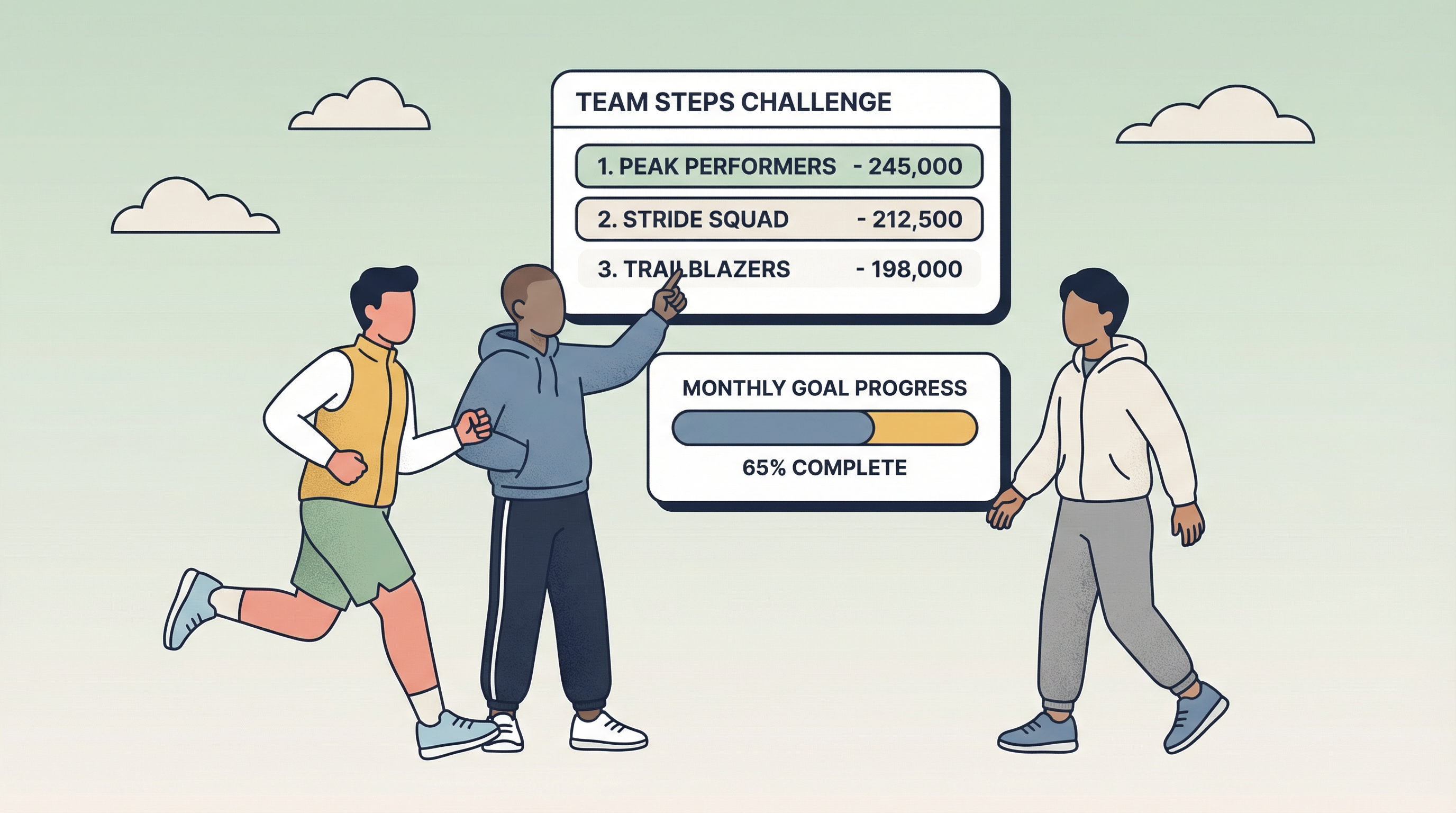
- Defining a clear objective before choosing the challenge type avoids the most common format mistakes
- An inclusive challenge combining walking, running and cycling gets 35% more participation than a single-activity challenge
- Internal communication is as important as the challenge itself: without visibility, there is no participation
- The most effective rewards are not the most expensive: day off, charitable donation, wellness account bonus
- Propulsion automates tracking, leaderboards and rewards to eliminate HR administrative burden
Why Corporate Sports Challenges Often Fail
Most corporate sports challenges start with enthusiasm and end in silence after 10 days. The reasons are always the same: wrong format, insufficient communication, too much friction to participate, and no mechanism to maintain engagement beyond the first week.
This guide covers every step of the process, from defining the objective to the final celebration, so your next sports challenge achieves 60%+ participation and leaves a lasting impression on your teams.
Step 1: Define the Objective Before the Format
Before deciding whether to launch a step challenge, a virtual race, or a multi-activity challenge, ask yourself: what is the real objective?
- Reduce absenteeism: focus on regular daily activity challenges (steps, active minutes)
- Strengthen team cohesion: prioritize team challenges with a visible leaderboard
- Promote employer branding: choose a photo or participatory format that is easy to share
- Improve overall engagement: combine physical activity and health content to reach all profiles
The objective determines the format. Choosing the format without a clear objective is the first mistake 80% of HR teams make.
Step 2: Choose a Truly Inclusive Format
A sports challenge that excludes less active employees does not fulfill its purpose. Inclusivity is not a bonus; it is the condition for program success.
- Step challenge: The most accessible. Suitable for all levels, no equipment required. Ideal for a first challenge.
- Multi-activity challenge: Each activity is worth a number of points. Walking worth 1 point, cycling 1.5, running 2. Everyone contributes at their level.
- Active minutes challenge: 30 minutes of activity per day, regardless of type. Yoga counts as much as running.
- Cumulative team challenge: The goal is collective. A very active employee compensates for a less sporty colleague. Reduces individual pressure.
Golden rule: if your least sporty employee cannot contribute meaningfully to the challenge, the format is too restrictive.
Step 3: Plan the Duration and Calendar
The optimal duration of a corporate sports challenge is 4 weeks. Here is why:
- Less than 2 weeks: Not long enough to create a habit or real team engagement
- 4 weeks: Long enough to see results, short enough to maintain urgency
- More than 6 weeks: Fatigue sets in, participation drops from week 5
Avoid holiday periods, busy end-of-quarter weeks, and weeks with multiple public holidays. The best periods: January-February (resolutions), April-May (spring energy) and September (back to work season).
Step 4: Build Effective Internal Communication
Communication is as important as the challenge itself. An excellent poorly communicated challenge gets the same participation as a mediocre one.
- 2 weeks before: Official announcement with teaser. Reveal the theme, not all the details yet. Create anticipation.
- 1 week before: Complete instructions, team formation, presentation of the tracking platform.
- Day 1: Launch with a message from leadership. Management involvement increases participation by 25%.
- Weekly: Leaderboard update, participant story, reminder of the objective.
- Last week: Create urgency. "Only 5 days left, the Marketing team is 200 steps away from overtaking Sales."
Recommended channels: Slack or Teams for daily updates, email for official announcements, physical signage if you have an office.
Step 5: Choose the Right Rewards
Rewards increase participation by 25 to 40%, but the best rewards are not necessarily the most expensive.
- Extra day off: The most desired reward according to employee surveys, and low cost for the company
- Donation to a charity of the winning team's choice: Reinforces the sense of social contribution
- Wellness account bonus: Directly linked to physical effort, consistent with the challenge objective
- Team experience: Dinner, activity or cooking class to create a collective memory
Create multiple prize categories: winning team, best progress, most consistent participant, most creative team. The more categories, the more people have a chance to win something.
Step 6: Ensure Tracking Without Creating Friction
Manual tracking is the enemy of participation. When employees have to enter their data manually every day, 40% drop out before the end of the first week.
Tracking solutions in order of preference:
- Automatic synchronization via mobile app connected to the phone or smartwatch: zero friction, maximum participation
- Simplified daily entry: A single field to fill in per day, accessible in 10 seconds
- Real-time visible leaderboard: Displayed on the platform and automatically shared in Slack
Propulsion fully automates this step. Activity tracking, real-time leaderboards and re-engagement notifications are managed by the platform: your HR team has nothing to do manually for the entire duration of the challenge.
The 5 Most Common Mistakes
- Launching without a teaser period: A challenge announced the day before gets 2x less participation than one prepared 2 weeks in advance
- Format too competitive: If less active employees feel they cannot win, they do not participate at all
- Forgetting remote work: Hybrid teams need a digital platform, not a shared Excel spreadsheet
- No mid-challenge re-engagement: Participation naturally drops in weeks 2-3 without re-engagement communication
- End without celebration: A challenge that ends without a ceremony leaves participants wanting more and reduces desire to join the next one
Keep reading
This guide covers execution. For the full framework (formats, timeline, participation KPIs and mistakes to avoid), go to the complete HR guide to corporate wellness challenges. Still unsure which type of challenge fits? The list of 50 health challenge ideas is a concrete starting point.
Frequently Asked Questions
What budget should you plan for a corporate sports challenge?
The budget varies depending on company size and chosen rewards. Count between $50 and $200 per employee for a complete challenge including the tracking platform and rewards. Companies using a platform like Propulsion significantly reduce administration costs, which often represent half the total budget of a manually managed challenge.
How do you manage remote employees in a sports challenge?
Virtual challenges work just as well as in-person challenges, sometimes better because they eliminate geographical barriers. Make sure the tracking platform is accessible on mobile, that communications go through digital channels like Slack, and that teams are mixed (remote and office) to create connections between colleagues who do not see each other regularly.
How many employees do you need to launch a sports challenge?
There is no absolute minimum, but a challenge works best from 15 to 20 participants to create real group dynamics and a competitive leaderboard. Below this threshold, consider partnering with other local companies or launching an individual rather than team challenge.
How do you maintain engagement after the challenge ends?
The end of a challenge is the best time to prepare the next one. Send a satisfaction survey within 48 hours, share the collective statistics achieved, announce the date of the next challenge during the closing ceremony, and keep the platform accessible for employees who want to continue tracking their personal activity.