
Workplace well-being
Remote Work and Well-Being: How to Keep Your Teams Connected and Healthy
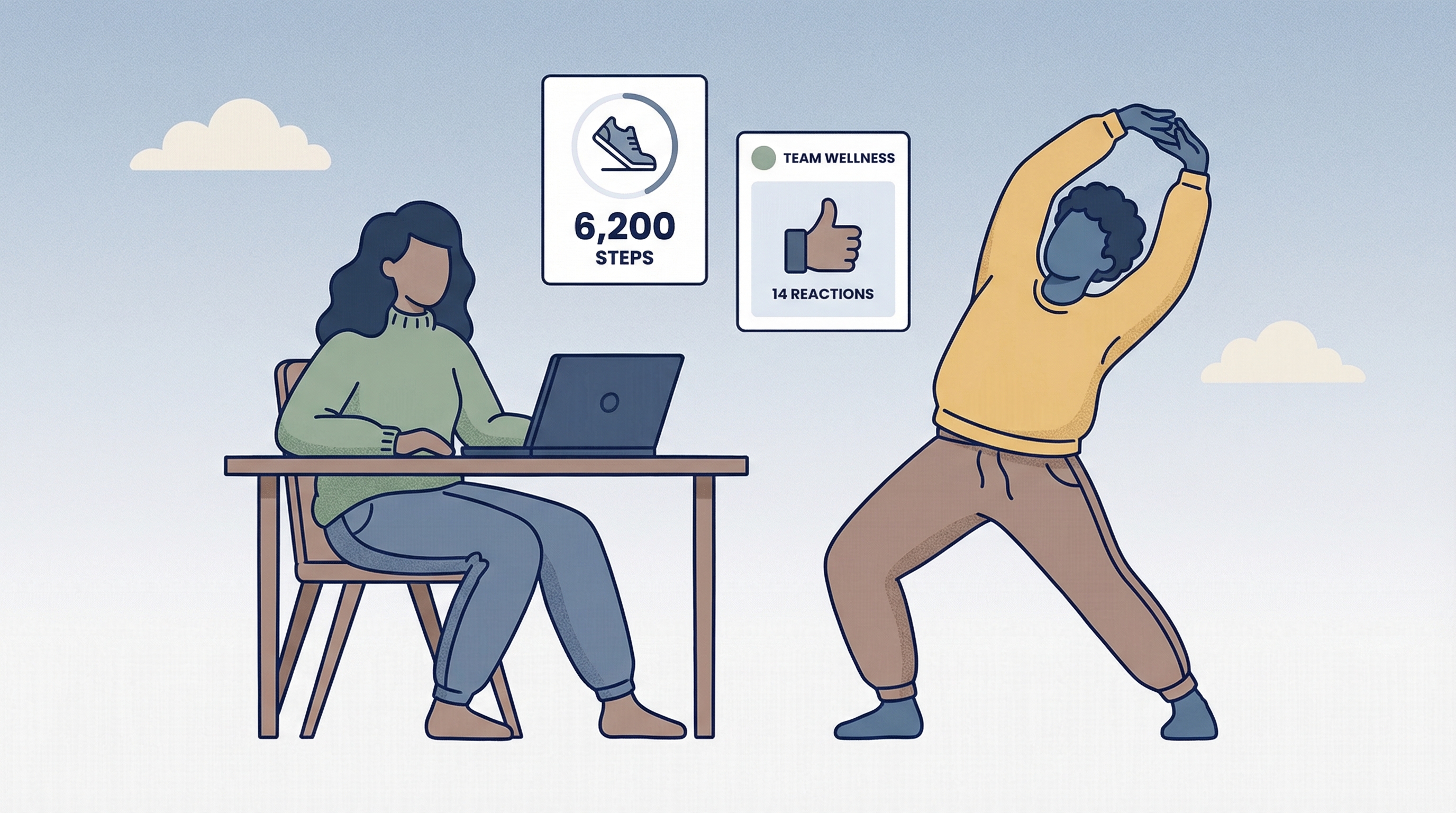
- 67% of remote workers are more sedentary than in the office; structured active breaks can reverse this trend
- Hybrid teams need intentional connection rituals because informal interactions naturally disappear
- Team health challenges work just as well remotely as in person, sometimes better as they create bonds between locations
- Mental health in remote work requires clear policies on the right to disconnect and working hours
- Propulsion is designed for distributed teams with automatic tracking, real-time leaderboards and integrated communication
The Real Impact of Remote Work on Employee Health
Since the massive adoption of remote work, HR teams face a paradox: employees appreciate the flexibility, but their physical and mental health often deteriorates without anyone noticing. No walk to the office, no spontaneous coffee breaks, no clear boundary between professional and personal life.
The numbers speak clearly: 67% of remote workers are more sedentary than in the office, 54% experience significant social isolation, and 45% have difficulty disconnecting at the end of the day. These three combined problems form a cocktail that increases absenteeism and reduces engagement over the long term.
Here are the strategies that actually work to reverse this trend.
Fighting Sedentary Behavior in Distributed Teams
In the office, employees naturally walk: to the meeting room, the cafeteria, a colleague's desk. Working from home, some employees take fewer than 1,000 steps per day. The structural sedentary nature of remote work requires structural interventions, not just general encouragement.
- Mandatory active breaks in the calendar: Block 10 minutes every 2 hours in the team calendar. Not optional, integrated into the work rhythm.
- Standing or walking meetings: One-on-ones and small follow-up meetings can be done while walking with earphones. Encourages mobility without reducing productivity.
- Team step challenges: A weekly leaderboard shared in Slack creates gentle social accountability. Colleagues motivate each other without excessive pressure.
- Publicly communicated step goal: When an employee shares their weekly goal with their team, the probability of achieving it increases by 33% according to social accountability research.
Maintaining Social Connection Remotely
Isolation is the number one challenge of remote work. Informal interactions, which represent 40% of communications in person according to research, almost entirely disappear remotely. They must be intentionally recreated.
- Structured virtual coffee breaks: 15 weekly minutes in random small groups of 3 to 4 people. No professional agenda, just conversation. Tools like Donut for Slack automate this process.
- Non-professional Slack channel: A channel dedicated to personal interests: recipes, weekend photos, humor. Reproduces the virtual water cooler.
- Cross-team health challenges: A challenge that groups employees from different departments creates connections that would never have existed in person. This is one of the hidden benefits of distributed wellness programs.
- Authentic virtual celebrations: Birthdays, promotions, births, marked with the same energy as in person. A Slack message is not enough. A virtual card signed by the whole team or a gift delivered at home leaves a lasting impression.
Protecting Mental Health in Hybrid Mode
Mental health in remote work is more complex to manage than physical health because it is less visible. An employee who does not walk: that can be measured. An employee suffering from silent burnout: much harder to detect remotely.
- Formalized right to disconnect: A written policy that specifies hours when employees are not required to respond to messages. Without a clear policy, the implicit pressure of permanent availability sets in.
- Weekly well-being check-ins: A simple question asked every Monday: "Out of 10, how are you this week?" Anonymous or named depending on team culture. Allows detecting weak signals before they become serious problems.
- Access to mental health resources: Employee assistance programs, guided meditation sessions, access to a psychologist via the wellness platform. These resources are underused when they are hard to find; they must be proactive and visible.
- Managers trained to detect burnout: Signals to watch for remotely: decrease in work quality, missed deadlines, reduced participation in meetings, shorter responses than usual.
Creating Team Rituals That Transcend Distance
Team rituals are the pillars of organizational culture. In person, they form naturally. Remotely, they must be intentionally designed and maintained.
- Daily standup with a personal touch: Start each standup with a light non-professional question. "What is the best thing you ate this week?" Two minutes of human connection before work.
- Friday collective debrief: 15 minutes every Friday to share a personal win from the week. Reinforces the sense of accomplishment and visibility of each person's contributions.
- Monthly shared challenge: A common challenge that changes each month. January: reading challenge. February: step challenge. March: healthy recipes challenge. Variety maintains engagement throughout the year.
- Planned in-person gatherings: For fully distributed teams, one in-person meeting per quarter transforms virtual colleagues into real relationships. The ROI in terms of cohesion and remote collaboration is significant.
How Propulsion Supports Hybrid Teams
Propulsion was designed from the start for distributed teams. Automatic activity tracking via the mobile app works whether the employee is in the office or working remotely anywhere in the country. Real-time leaderboards create friendly competition between colleagues who do not see each other physically.
The activity feed feature allows employees to share their health accomplishments, comment on teammates' performances and create a virtual community around well-being. It is the digital water cooler that distributed teams are looking for.
Keep reading
Remote work amplifies issues that exist everywhere. 50 employee wellness program ideas give the general frame, 5 workplace mental health strategies tackle isolation head-on, and the corporate wellness challenge guide explains why collective challenges work especially well on distributed teams.
Frequently Asked Questions
How do you measure the well-being of remote teams?
Key indicators to track are the participation rate in virtual social activities, results from weekly well-being surveys, physical activity level via a tracking platform, absenteeism rate, and engagement scores from quarterly surveys. The combination of quantitative data (activity, attendance) and qualitative data (surveys) gives the most complete picture.
Do health challenges really work for remote teams?
Yes, and often better than in person for a surprising reason: they create bonds between employees who would never have interacted otherwise. A step challenge grouping teams from different cities generates conversations and camaraderie that spill over into professional collaboration. Distributed teams report higher participation rates than in-person teams on well-designed challenges.
What is the ideal frequency for virtual team building activities?
Research suggests at least one social touchpoint per week to maintain the sense of connection in remote work. This can be as simple as an informal question in the daily standup. More structured activities like challenges or virtual coffee breaks in groups work better monthly to avoid virtual meeting fatigue.
How do you manage different time zones in a wellness program?
Prioritize asynchronous challenges where everyone contributes at their own pace rather than real-time activities. Step challenges, reading challenges or nutrition challenges require no calendar synchronization. When synchronous activities are necessary, alternate schedules so the same time zone is not always penalized.