
Employee benefits
Wellness Spending Accounts: Complete Employer Guide 2026
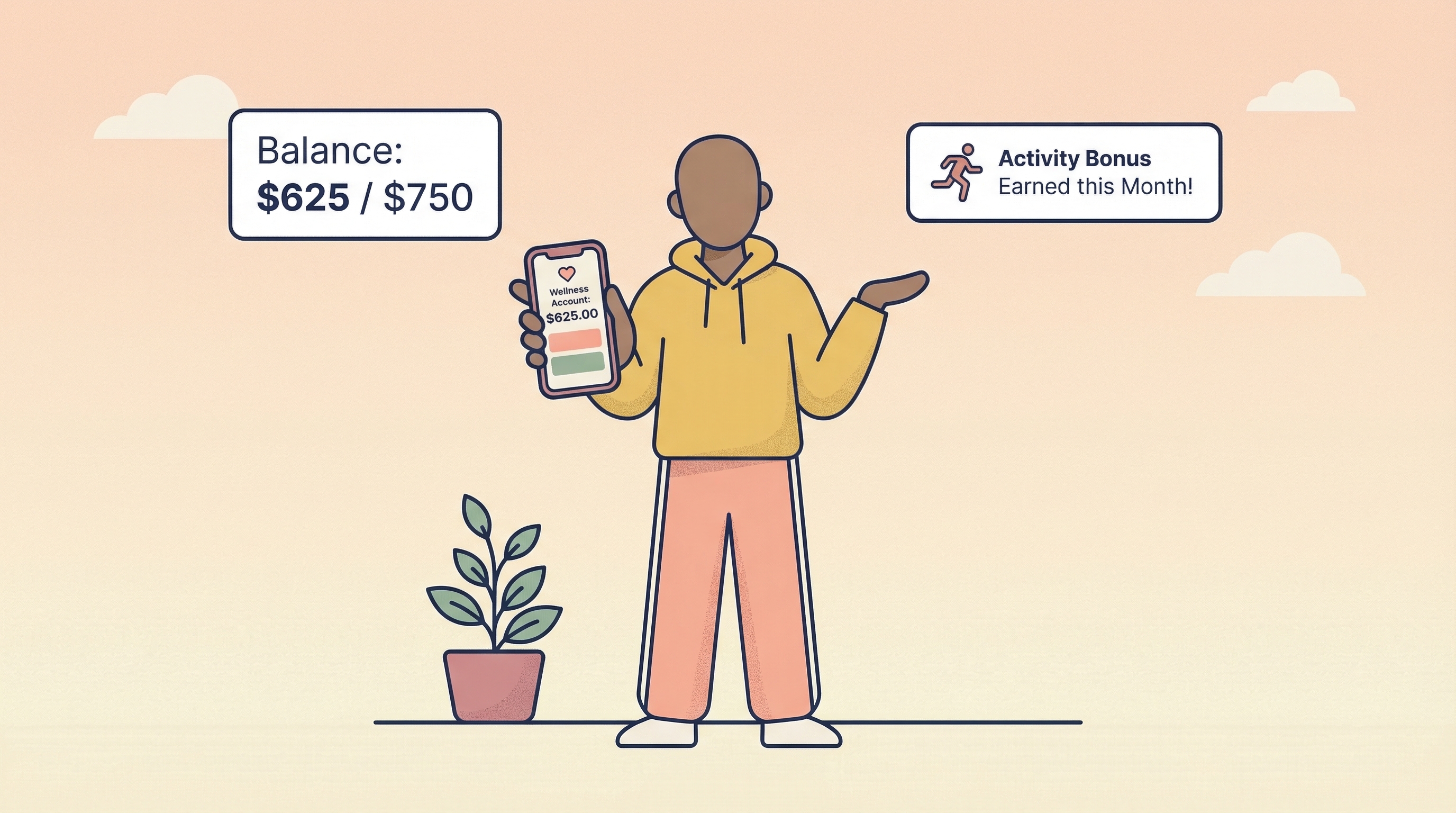
- A wellness spending account is a flexible annual amount that employees use for health and wellness expenses of their choice
- Unlike rigid group insurance, the wellness account adapts to the individual needs of each employee
- The most common amounts range from $500 to $1,500 per employee per year
- Tax treatment depends on eligible expense categories: some are non-taxable, others constitute a taxable benefit
- Propulsion manages wellness accounts and can automatically boost balances based on participation in health challenges
What is a Wellness Spending Account?
A wellness spending account (also called a health account or wellness allowance) is an annual amount allocated by the employer that the employee can use freely for health and wellness-related expenses. Unlike group insurance that covers very specific care categories according to a fixed schedule, the wellness account gives the employee choice, and that is precisely what makes it one of the fastest-growing employee benefits in Canada.
This progression reflects a profound shift in how employers design benefits: from a paternalistic model where the company decides what is good for the employee, toward a trust-based model where the employee chooses what they need.
Wellness Account vs Group Insurance: What is the Difference?
The two are not mutually exclusive: most companies that offer a wellness account also maintain their group insurance. Here is how the two complement each other:
- Group insurance: Covers essential medical care: prescription drugs, dental care, vision, hospitalization. Reimbursement upon submission of receipts according to a predefined schedule. Generally a non-taxable benefit.
- Wellness spending account: Covers wellness expenses in the broad sense: gym membership, sports equipment, yoga classes, meditation app, office ergonomics, nutrition, mental health outside EAP. Fixed amount freely usable by the employee according to categories defined by the employer.
The wellness account fills the blind spots of group insurance: all those expenses that improve quality of life but are not covered by traditional plans.
Eligible Expense Categories
This is one of the most important decisions in designing a wellness account: which expense categories will you include? The broader the list, the more inclusive the account, but the more complex the tax treatment becomes.
Most common categories
- Physical activity: Gym membership, group classes, sports equipment, cycling, swimming, martial arts, yoga, pilates
- Mental health: Meditation apps (Calm, Headspace), psychology sessions not covered by insurance, stress management courses
- Ergonomics and home office: Ergonomic chair, standing desk, external monitor, lighting, comfort accessories
- Nutrition: Nutritionist consultation, healthy meal service subscription, vitamin supplements
- Sleep and recovery: Mattresses, ergonomic pillows, sleep tracking applications
- Active transportation: Bicycle, cycling accessories, transit passes
- Personal development: Online courses, books, certified training outside work
- Preventive care: Massage therapy, osteopathy, acupuncture, naturopathy
Categories to include with caution
- Travel and vacations: Some employers include a travel component to encourage disconnection, but the tax treatment is more complex
- Pets: Studies show pets contribute to mental well-being, but including veterinary costs is rare and potentially taxable
- Childcare: Eligible in some plans, but governed by specific federal and provincial tax rules
Tax Treatment: What You Need to Know
This is often the most poorly understood part of wellness accounts. Tax treatment depends on the nature of the expenses reimbursed.
Generally non-taxable expenses
Reimbursements for medical expenses within the meaning of the Income Tax Act (massage therapy, osteopathy, psychology, glasses, certain medical equipment) can be treated as non-taxable benefits if the plan is structured as a compliant Health Spending Account (HSA).
Generally taxable expenses
Reimbursements for general wellness expenses (gym membership, sports equipment, yoga classes, non-medical home office) constitute a taxable benefit for the employee. The employer must include them in the employee's T4.
The pragmatic solution
Most companies opt for a mixed wellness account where some categories are non-taxable (healthcare) and others are taxable (general wellness), with transparent communication to employees on the tax treatment of each category. Consult your accountant or tax specialist to validate the structure specific to your situation.
How Much to Allocate? The Most Common Tiers
Amounts vary by company size, industry and overall compensation strategy. Here are the tiers most commonly used by employers:
- Basic program: $300 to $500 per employee per year. A symbolic but appreciated gesture. Enough to cover a gym membership or a few massage therapy sessions.
- Standard program: $500 to $1,000 per employee per year. The most frequently chosen tier. Allows a real impact on lifestyle habits.
- Generous program: $1,000 to $2,500 per employee per year. Reserved for companies that position benefits as a strong competitive advantage in the talent market.
- Exceptional program: $2,500 and above. Rare, but present in technology and financial sectors to attract highly sought-after profiles.
How to Structure Your Program: 5 Key Decisions
1. Annual amount and usage period
Define the allocated amount and the period during which it can be used: calendar year, company fiscal year, or 12 rolling months from the hire date. Decide whether unused balances are forfeited or carried over to the following year. Most employers opt for forfeiture of unused balances to encourage active use.
2. Eligible expense categories
Establish a clear list of eligible categories with concrete examples. The more precise the list, the fewer ambiguous requests you will have to process. Some employers opt for a very explicit closed list; others prefer an open list with a guiding principle (any expense directly contributing to physical or mental health).
3. Reimbursement process
Two main models: reimbursement on receipt submission (more control, more administration) or a dedicated prepaid card (less administration, less control). Receipt reimbursement remains most common for tax reasons.
4. Eligibility and waiting period
Decide whether the account is accessible from day one or after a probationary period. Immediate access sends a strong signal of inclusion and trust; a 3 to 6-month delay is common but can frustrate new employees who joined precisely for the benefits.
5. Communication and visibility
A poorly communicated wellness account is an unused wellness account. Plan communication at onboarding, a quarterly reminder of available balance, and a year-end reminder for unused balances.
The Propulsion Model: Wellness Account with Activity Bonuses
Propulsion introduces a new dimension in wellness account management: automatic bonuses based on participation in health challenges. The principle is simple: an employee who actively participates in company challenges sees their wellness account automatically boosted.
Concrete example: a base account of $600, with a $50 bonus for each completed challenge. An employee who completes 4 challenges in the year receives a total of $800. This mechanism creates a direct incentive to participate in wellness programs while rewarding engagement tangibly.
Propulsion also manages complete administration: real-time balance tracking, receipt submission via app, automatic validation of eligible categories, and monthly HR reports. The HR team moves from manual reimbursement management to strategic program oversight.
Keep reading
A wellness spending account sits inside a broader offer. Our article on optimizing your employee benefits offer shows where it fits against the rest, and the 10 key features of a wellness app give the criteria for choosing the tool that runs it. If your priority is getting teams moving, 50 employee wellness program ideas complement the individual allowance with collective formats.
To see how it all fits into a single platform, book a demo.
Frequently Asked Questions
Can a wellness account replace group insurance?
No, and it is important to make this distinction clearly to employees. The wellness account complements group insurance but does not replace it. Insurance covers major risks (costly medications, hospitalization, disability) that the wellness account is not designed to handle. The two are complementary and address different needs.
Are part-time employees entitled to the wellness account?
This is a business decision you make when designing the program. Some employers offer a prorated account based on hours worked, others a uniform amount for everyone, others still reserve the benefit for full-time employees. The trend is toward inclusion of part-timers, at least with a reduced amount, for equity and attractiveness reasons.
How do you handle reimbursement requests for ambiguous expenses?
Establish a written policy with explicit examples of inclusions and exclusions before the program launch. For ambiguous cases, create a simple validation process, such as an HR team decision within 48 hours. Document each decision to create consistent internal precedent. Over time, ambiguous requests naturally decrease as employees understand the program boundaries.
Do you need dedicated software to manage a wellness account?
For fewer than 25 employees, a spreadsheet may suffice. Beyond that, a dedicated tool quickly becomes justified to avoid tracking errors, automate balance reminders and produce year-end tax reports. The administrative time saved by a tool like Propulsion generally exceeds its cost starting from 30 to 40 employees.